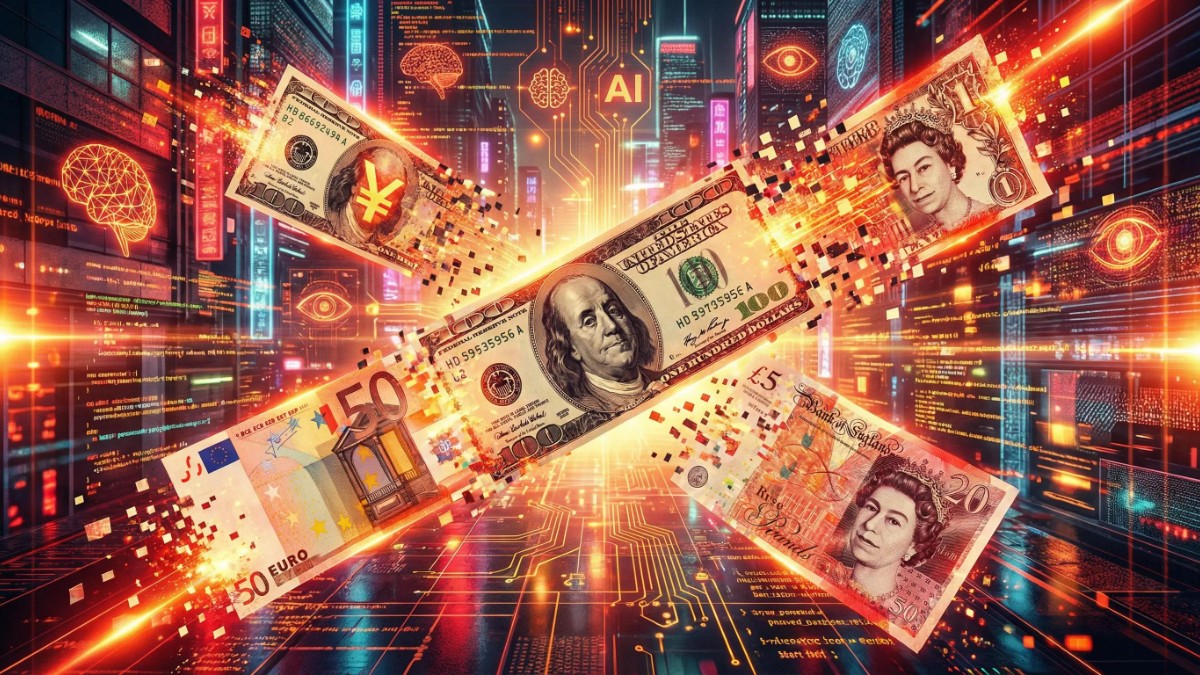
The Global Shift Toward AI-Driven Payment Ecosystems
The global financial system is undergoing a structural transformation. Artificial intelligence is not only optimizing banking operations but actively reshaping how value moves across economies. One of the most visible consequences is the rapid decline in physical banknotes circulating worldwide.
Digital payment platforms powered by AI are becoming faster, safer, and more predictive. As a result, the reliance on physical cash continues to diminish across developed and emerging markets.
Why AI Makes Digital Payments More Attractive Than Cash
Artificial intelligence enhances fraud detection in real time. It analyzes transaction patterns, flags anomalies instantly, and prevents unauthorized transfers before they are completed.
Cash cannot compete with that level of intelligence. Physical money offers no automated risk monitoring, no transaction history, and no predictive financial insights.
Consumers increasingly prefer payment systems that provide instant security alerts, spending categorization, and financial forecasting tools.
Contactless Payments and Behavioral AI
Contactless payments have surged in popularity. AI systems analyze behavioral patterns to speed up authentication and reduce friction.
Machine learning models recognize purchasing habits and adjust security thresholds dynamically.
Cash transactions require physical exchange, while AI-driven systems require only authentication signals and encrypted approval.
Super Apps and Financial Consolidation
Super apps integrate banking, shopping, transfers, and investments into a single ecosystem. Artificial intelligence personalizes offers and predicts financial needs.
When consumers operate inside these digital environments daily, physical cash becomes increasingly irrelevant.
AI, Real-Time Credit Decisions, and Embedded Finance
Embedded finance platforms use AI to evaluate creditworthiness in seconds. Purchases can be financed instantly at checkout.
Cash cannot support dynamic credit scoring or flexible micro-loans. AI-powered systems integrate financial decisions directly into the transaction process.
The Role of Central Bank Digital Currencies
Many central banks are exploring digital currencies supported by AI infrastructure.
These systems allow programmable money, transaction monitoring, and economic policy adjustments in real time.
Physical banknotes lack programmability and analytical feedback loops.
Declining ATM Networks
As digital payments grow, ATM usage declines. Banks reduce physical infrastructure investments.
AI predicts transaction demand, helping institutions optimize branch closures and digital service expansion.
Retail Transformation Through AI Payments
Retailers increasingly adopt AI-based checkout systems. Automated stores eliminate traditional cash registers.
Computer vision and digital wallets replace physical currency exchange.
Economic Efficiency and Cost Reduction
Managing cash involves printing, transportation, storage, and security costs.
AI-driven digital systems significantly reduce these expenses while increasing scalability.
Data-Driven Economic Planning
Governments gain real-time economic insights when transactions occur digitally.
AI models aggregate consumption data to forecast inflation trends and economic slowdowns.
Cash-based economies provide delayed and fragmented reporting.
Cybersecurity and AI Defense Systems
Digital payments introduce cybersecurity risks. AI counteracts these risks through adaptive threat detection.
Machine learning identifies evolving fraud techniques faster than static security systems.
Financial Inclusion and AI Micro-Transactions
AI-powered mobile wallets expand financial access in underserved regions.
Individuals without traditional banking infrastructure can participate in digital economies.
However, access to devices and internet connectivity becomes essential.
Environmental Impact of Reducing Cash
Producing physical currency consumes raw materials and energy.
Digital systems, despite requiring data centers, eliminate paper production and transport emissions.
Psychological Shift in Money Perception
Digital money changes spending psychology. AI budgeting tools provide instant financial feedback.
Consumers interact with dashboards rather than physical wallets.
Small Businesses and AI Adoption
Small businesses increasingly rely on AI-driven payment processors.
These systems provide analytics, sales forecasting, and customer insights.
Cash transactions do not generate comparable strategic data.
Regulatory Challenges
As AI payment platforms dominate, regulatory frameworks struggle to adapt.
Cross-border data flows and algorithmic decision-making require updated compliance standards.
Privacy vs Innovation Debate
The reduction of physical cash raises concerns about financial privacy.
AI-powered systems collect detailed behavioral data.
Balancing efficiency with civil liberties becomes a central policy debate.
Hybrid Financial Futures
Some economies maintain limited cash availability while accelerating AI integration.
This transitional phase may not last indefinitely.
The Long-Term Outlook
The decline of physical banknotes is unlikely to reverse.
AI-driven payment platforms continue improving security, personalization, and economic efficiency.
As infrastructure expands and adoption deepens, cash may shift from necessity to legacy artifact.
For ongoing insights into AI-driven financial evolution, visit Sueio.
AI and the Collapse of Transaction Friction
One of the primary drivers behind the disappearance of physical cash is friction elimination. Artificial intelligence minimizes every delay traditionally associated with financial transactions. Approval times shrink to milliseconds. Fraud checks happen invisibly. Currency conversion is automated instantly.
Cash requires physical presence, manual exchange, and human verification. AI-powered platforms remove these barriers, making digital payments not only convenient but structurally superior in efficiency.
Predictive Consumption and Invisible Payments
AI systems increasingly predict consumer purchases before they happen. Subscription models, automated restocking services, and embedded payments operate in the background.
In many digital ecosystems, payments become invisible. Consumers approve once, and AI manages recurring financial interactions autonomously.
Cash cannot exist inside predictive automation frameworks.
Biometric Authentication Replacing Physical Exchange
Biometric technologies integrated with AI are redefining authentication. Facial recognition, fingerprint scanning, and behavioral biometrics eliminate passwords and physical signatures.
Payment authorization shifts from physical money exchange to identity verification.
The act of paying transforms from handing over banknotes to confirming biometric identity.
Smart Cities and AI Financial Infrastructure
Smart cities rely on interconnected digital systems. Public transport, toll roads, parking, and utilities integrate AI-powered payment platforms.
Physical cash becomes impractical in fully automated urban infrastructures.
As cities digitize services, the relevance of paper currency declines naturally.
Cross-Border AI Payment Networks
Traditional international transfers involve intermediaries and time delays.
AI-driven payment networks optimize routing paths, detect currency arbitrage opportunities, and reduce settlement times dramatically.
In cross-border commerce, physical cash plays virtually no role.
The Rise of Autonomous Commerce
Autonomous commerce refers to machines conducting transactions without human initiation. Smart appliances reorder supplies. Vehicles pay tolls automatically. IoT devices manage subscription renewals.
Artificial intelligence orchestrates these interactions.
Physical banknotes cannot function within machine-to-machine financial ecosystems.
Retail Automation and Cashless Stores
Retail automation technologies powered by AI are expanding globally. Computer vision systems track items removed from shelves and charge customers automatically.
Checkout counters disappear. Cash registers become obsolete.
The consumer simply walks out, and payment processes invisibly.
Financial Data as Strategic Asset
Transaction data has become a strategic economic asset. Companies analyze purchasing patterns to forecast demand, personalize marketing, and optimize inventory.
Cash transactions generate no structured data.
AI thrives on data. Therefore, digital payments become economically more valuable than anonymous banknotes.
Corporate Strategy and Cash Elimination
Large corporations increasingly prefer digital-only payment models. Handling cash introduces operational risks, theft exposure, and accounting complexity.
AI-powered financial dashboards simplify reconciliation and auditing processes.
Operational incentives naturally push businesses away from physical currency.
AI and Real-Time Tax Compliance
Governments are integrating AI systems to monitor tax compliance in real time.
Digital payments create immediate reporting capabilities.
Cash transactions historically enabled underreporting or delayed declaration.
As AI auditing strengthens, cash becomes less attractive within formal economies.
Economic Transparency vs Informal Markets
Digital AI-driven payment ecosystems increase economic transparency.
However, informal markets traditionally rely on physical cash.
The disappearance of banknotes may reshape underground economies and alter informal labor structures.
Financial Behavior Modeling
AI builds dynamic financial profiles of individuals and businesses.
Spending patterns, saving habits, and credit usage form predictive models.
These models enable hyper-personalized financial services but also expand monitoring capabilities.
Consumer Loyalty Systems Powered by AI
Digital payments integrate directly with loyalty programs. AI analyzes purchase frequency and recommends tailored rewards.
Cash transactions cannot be linked to behavioral incentives as effectively.
Digital Wallet Dominance
Mobile wallets consolidate multiple payment methods into single platforms.
Artificial intelligence manages spending summaries, fraud alerts, and budget forecasts.
The physical wallet gradually loses its traditional function.
AI, Inflation Monitoring, and Monetary Policy
Central banks gain access to granular transaction data in digital economies.
AI models monitor price fluctuations across sectors in near real time.
This enhances monetary policy precision compared to historical reporting methods reliant on surveys and delayed data.
Resilience and Systemic Risks
Fully digital payment ecosystems introduce systemic cyber risks.
AI strengthens defense mechanisms but also creates concentration vulnerabilities if infrastructure centralizes excessively.
Physical cash historically served as a fallback during digital outages.
Digital Dependency and Infrastructure Reliability
Electricity, internet connectivity, and cloud infrastructure become prerequisites for economic participation.
Regions with unstable connectivity may struggle in fully cashless environments.
AI expansion increases dependence on technological stability.
Geopolitical Implications of AI Financial Networks
Countries developing advanced AI payment systems gain competitive advantage in global trade.
Digital financial ecosystems become tools of economic diplomacy and influence.
The decline of physical cash is intertwined with global technological competition.
The Cultural Meaning of Cash in Transition
Beyond economics, physical currency carries symbolic value. It represents tangible ownership and immediate exchange.
As AI-driven payments dominate, cultural perceptions of money evolve from physical object to digital abstraction.
Long-Term Structural Shift
The accelerated disappearance of physical cash is not merely a technological upgrade.
It reflects a structural transformation of financial infrastructure driven by artificial intelligence.
Payment platforms powered by AI are redesigning how economies operate, how governments regulate, and how individuals interact with value.